


Same Facts, Different Feelings: The Framing Effect in Hospitality

Updated: Dec 16, 2025
Every time a guest walks through your doors, they’re not just choosing what to eat or drink. They’re deciding how they feel about your restaurant. That feeling is rarely shaped by objective facts. It’s often shaped by how those facts are delivered. The framing effect is the invisible force behind every guest interaction, turning simple words into lasting memories or missed opportunities.
Every shift, guests make split-second decisions:
Do we stop here or keep walking?
Do I trust the server’s recommendation or play it safe?
Is that mistake forgivable or something I’ll remember later?
These choices are driven by how that information is presented—by your words, your tone, and your body language. That’s the framing effect: the same message can land completely differently depending on how it’s wrapped.
In hospitality, guests don’t just hear what you say; they feel how you say it.
Behavioral research shows that people respond very differently to the same option depending on whether it’s framed as a gain or a loss, even when the outcome is identical. Our brains are much more sensitive to “losing” something than to gaining the exact same thing.
“Free” works better than a percentage off because the brain doesn’t evaluate it logically—it reacts emotionally. A percentage discount still triggers mental math and the pain of paying, while the word “free” bypasses calculation altogether and feels like a pure gain. Psychologically, free removes risk, effort, and loss in a way discounts don’t, even when the value is identical. That’s why “on the house” feels generous and memorable, while “10% off” often feels forgettable.

In simplest terms, guests react more to how a message feels than to the neutral facts behind it. “It’s a 45-minute wait” and “We can have a table ready in about 45 minutes” are describing the same reality, but they create very different emotional responses. The first is a 45-minute loss. The second is a gain after 45-minutes.
The Framing Effect in Hospitality
The framing effect in hospitality isn’t just theory. It shows up in almost every guest interaction, from the host stand to the final check.
When delivering delays or constraints:
Don’t just state the delay. Give context and a next step.
Instead of:
“Your order will be right out.”
Try:
“So sorry about the delay on your meal. It’s taking a little longer than normal because we had two big tables ring in right before you, but you are in the queue and I’ll come back with an update in a few minutes.”
Why it works:
Guests handle waiting better when they feel informed, not ignored. A clear reason plus a specific follow‑up makes the wait feel managed instead of mysterious.
When the restaurant is busy:
Avoid framing the shift as chaos or overload.
Instead of:
“We’re slammed. It’s at least a 45-minute wait.”
Try:
“We’ve got a full house tonight and we’re managing the flow so everyone has a great experience. We can have a table ready for you in about 45 minutes. Would you like to relax at the bar while you wait?”
Why it works:
“Busy” can feel fun and energetic or stressful and out of control. The latter frames the wait as care and control—not chaos.
When enforcing policies:
Frame policies as standards that protect everyone’s experience.
Instead of:
“We don’t do substitutions.”
Try:
“That dish is prepared as is, but if you’re looking for something without cheese/gluten/etc., I have a couple of other options that would work really well.”
Why it works:
A flat “no” feels like a wall; a guided alternative feels like help. The guest hears, “I can’t do that, but I’m still on your side.”
When something goes wrong:
Frame the moment as being handled, not argued.
Instead of:
“That’s what you ordered.”
Try:
I'm sorry that wasn't what you were expecting. Let me take this back and see what I can do to fix it for you.”
Why it works:
Taking ownership settles the guest; defending the mistake inflames it. The frame moves the focus from blame to resolution.
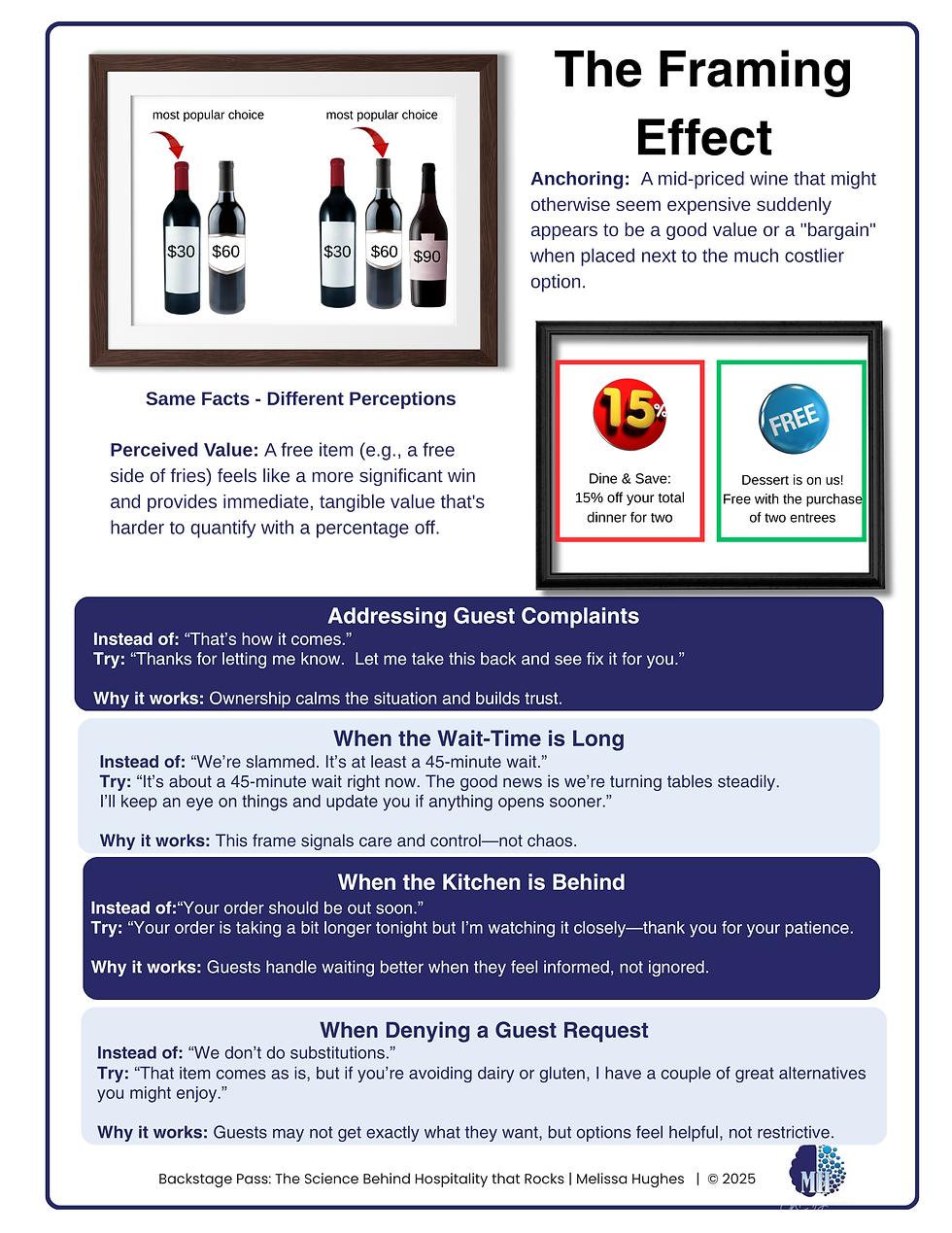
Share this article with your team, or download this one-page PDF to post in your restaurant as a quick, practical reminder that how we say things matters just as much as what we say.
Small shifts in framing can calm busy moments, reduce friction, and create better guest experiences—one interaction at a time. It's not manipulation; it’s service with emotional intelligence. The framing effect is a reminder that guests are human. They respond to how information feels at least as much as to what it is. When teams master the art of reframing, it becomes muscle memory.
The reality doesn’t change—but the guest’s perception does. And in hospitality, reality matters, but perception is what they remember when they decide whether to come back.


This is so true. That only saying Presentation is Everything!
this is the kind of stuff that separates the amateurs from the pros!
Good stuff!