


Apologies in Hospitality: The Neuroscience Behind Turning Mistakes Into Loyalty

Here’s a truth most people underestimate: A mistake followed by a genuine apology can build more trust than getting everything right the first time.
That sounds backwards, doesn't it?
When we understand how the brain evaluates experiences, it makes perfect sense. The brain doesn’t evaluate experiences like a checklist. It encodes emotional contrast. When something goes wrong, the emotional stakes rise. And when that moment is met with ownership, empathy, and follow-through, the brain experiences one of the strongest trust-building shifts available to humans.
Mistakes don’t destroy trust. The way we handle them can.

This is the Apology Effect: the neuroscience behind why a sincere apology doesn’t just repair damage. It can deepen loyalty, strengthen relationships, and leave a longer-lasting imprint than perfection ever could.
The Brain’s Negativity Bias:
Why Mistakes Hit Hard
First, the bad news.Your guest’s brain is wired with a negativity bias—an ancient survival mechanism that makes threats and problems register more strongly than pleasant moments.
In hospitality terms? A cold entrée lands harder in the brain than a perfectly cooked one.
Negative experiences light up the amygdala, the brain’s emotional alarm system, with greater intensity than positive ones. A wealth of research shows it can take five positive interactions to counterbalance a single negative experience.
👉 If you want to see how deeply this bias shapes perception and memory, this post on how the brain rewrites reality is a great companion read: The Negativity Bias: Why the Bad Stuff Sticks
The Service Recovery Paradox: When Mistakes Become Opportunities
When a service failure is handled exceptionally well, guest satisfaction and loyalty can actually exceed what it would have been if nothing had gone wrong.
Why? Because the brain remembers the emotional journey, not just the outcome.
When a problem is resolved with speed, empathy, and genuine care, the guest’s brain experiences a powerful sequence:
1. Relief – the threat is removed
2. Surprise – expectations are exceeded
3. Gratitude – someone cared enough to fix it
4. Trust – “They’ll take care of me”
That emotional arc activates the brain’s reward system, releasing dopamine and strengthening memory formation. This is also a textbook example of the Peak-End Rule: the brain’s tendency to judge experiences based on the most intense moment and how the experience ends.
A service failure creates a negative emotional peak. A stellar recovery creates a new peak... one that can override the original mistake, especially when it happens near the end of the experience.
👉 If this concept resonates, you’ll love this deeper dive on the Peak End Effect in Hospitality

The Language of Forgiveness: Words That Rewire the Brain
Not all apologies are created equal. The brain is exquisitely sensitive to language, and it knows when responsibility is being dodged.
"Often it isn’t the mistake that lingers, but whether dignity and safety are restored in the moment that follows." - Jonathan Solomon
What Doesn’t Work
· “I’m sorry you feel that way” (deflects responsibility, triggers defensiveness)
· “Sorry about that” (vague, emotionally hollow)
· “The kitchen messed up” (shifts the blame and stays focused on the problem)
What Does Work
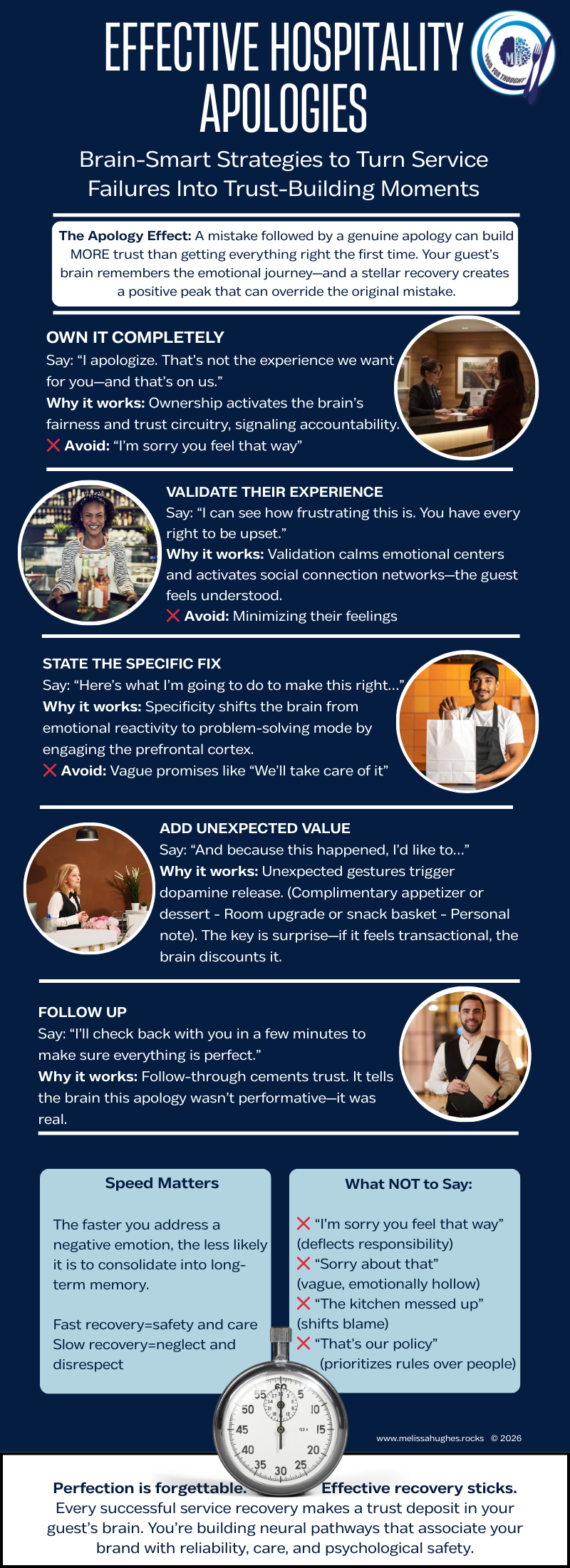
1. Own it completely
“I apologize. That’s not the experience we want for you, and that's on us.”
Ownership activates the brain’s fairness and trust circuitry, signaling accountability.
2. Validate their experience
“I can see how frustrating this is. You have every right to be upset.”
Validation calms the emotional centers and activates social connection networks—the same systems involved in feeling understood.
3. State the specific fix
“Here’s what I’m going to do right now to make this right…”
Specificity shifts the brain from emotional reactivity to problem-solving mode by engaging the prefrontal cortex.
4. Add unexpected value
“And because this happened, I’d like to…”
Unexpected gestures trigger dopamine release. The key is surprise. If it feels transactional, the brain discounts it.
5. Follow up
“I’ll check back with you in a few minutes to make sure everything is perfect.”
Follow-through cements trust. It tells the brain this apology wasn’t performative. It was real.

The Empathy Advantage: Mirror Neurons at Work
When a team member responds with genuine empathy, something remarkable happens in the guest’s brain: mirror neurons fire. Mirror neurons cause us to unconsciously mirror the emotional states we observe. Authentic concern from your team literally helps shift the guest’s brain from anger to calm, from frustration to connection.
This is why scripted apologies fall flat. The brain detects inauthenticity through tone, facial expression, and body language long before words land.
👉 If you want to explore how emotional states spread instantly in hospitality spaces, this article connects the dots: How Mirror Neurons Shape the Guest Experience
Speed Matters: The Neuroscience of Timing
Timing isn’t just operational. It's neurological. The faster a negative emotion is addressed, the less likely it is to consolidate into long-term memory. Delay too long, and the guest’s brain has already started writing the story they’ll retell later.
Fast recovery signals safety and care.
Slow recovery signals neglect and repeat risk.
The Bottom Line
Perfection is forgettable. Recovery is unforgettable. When something goes wrong, remember: your guest’s brain is wired to remember how you made them feel in that moment.
Own it.
Validate it.
Fix it fast.
Add unexpected value.
Follow through.
Every successful service recovery makes a trust deposit in your guest’s brain.
You’re building neural pathways that associate your brand with reliability, care, and psychological safety. Over time, those pathways strengthen.
Effective apologies in hospitality are the greatest opportunity for guest loyalty.
👇👇👇👇 Download this infographic to share with your team.👇👇👇👇


Melissa, it’s been a pleasure to read this.
You’ve given real language and structure to something deeply human, how trust is repaired, not just explained.
Thank you.
This is so true. People are much more understanding when the server is humble.
I wish I would have had this article last week. We went out to eat and the server screwed up royally and forgot to order the kid's meal. The 6 year old had to wait while everyone else had their food. One person in our party heard the kitchen staff talking about it on the way back from the restroom. We really weren't angry -- until he blamed it on the kitchen. That made it so much worse.
It's so true that we would have been understanding if he just would have apologized. But placing the blame on people who can't even defend themselves was just wrong.