


Psychological Safety at Work: Why Smart Teams Go Silent (and How to Fix It)

Updated: 5 days ago
By Dr. Melissa Hughes, updated November 2026
Picture a meeting. The leader asks, "Any concerns before we move forward?"
Silence. A few nods. Everybody files out.
Twenty minutes later, three of those people are in the hallway explaining exactly why the plan won't work.
That isn't a communication problem. It's a brain problem. And it has a name: a lack of psychological safety.
Psychological safety is one of the most studied (and most misunderstood) ideas in modern leadership. It isn't about being nice. It isn't about lowering the bar. It comes down to whether the brain sitting in that meeting decides that speaking up is a reward or a risk.
The short version
Psychological safety is felt permission to speak up without being punished or humiliated.
The best teams don't make fewer mistakes. They talk about them more.
Under social threat, the brain shifts resources from thinking to self-protection.
Leaders build it through everyday behavior, not posters or policies.
What Is Psychological Safety?
Psychological safety is the shared belief that a team is safe for interpersonal risk taking.
In plain language: you can ask a question, admit a mistake, float a half-baked idea, or disagree with the boss without being embarrassed, punished, or quietly written off.
Harvard Business School professor Amy Edmondson, who has spent more than two decades researching it, calls it "felt permission for candor."
Notice the word felt. Psychological safety isn't a policy in the handbook or an open-door poster in the break room. It lives in each person's prediction about what will happen next if they open their mouth.
The Hospital Study That Started It All
Edmondson stumbled onto psychological safety by accident in the 1990s while studying medication errors in hospital teams. She expected the best teams to make the fewest mistakes.
The data said the opposite. The highest-performing teams were reporting more errors.
Were the best teams actually worse? Nope. They were simply willing to talk about their mistakes. The other teams were making errors too. They just weren't saying so.
A mistake no one admits is a mistake no one learns from.
That finding flipped the question from "How do we stop people from making mistakes?" to "How do we make it safe to surface them?"
Her research since then shows that psychological safety matters most where work is uncertain and interdependent: anywhere success depends on judgment, creativity, and collaboration rather than following a script.
What Google Discovered About Its Best Teams
Years later, Google went looking for the formula behind its most effective teams. The study, code-named Project Aristotle, examined 180 teams.
Researchers expected the answer to be the right mix of talent: the smartest people, the right skills, the perfect personalities.
It wasn't. Of the five dynamics that separated great teams from the rest, psychological safety came out on top, and it made the other four possible.
Who was on the team mattered far less than how the team worked together.

Your Brain on Threat: Why Fear Makes Teams Dumber
Your brain has one job above all others, and it isn't thinking. Its first job is keeping you alive.
It's a remarkably well-calibrated danger detector, and it doesn't make much of a distinction between a predator in the grass and a raised eyebrow from your manager.
When the brain senses a social threat, three things happen fast:
The amygdala sounds the alarm.
Stress hormones rise.
The prefrontal cortex starts going offline. That's the part of the brain responsible for focus, problem solving, creativity, and impulse control.
Yale researcher Amy Arnsten has shown that even mild, uncontrollable stress can rapidly impair this thinking part of the brain. You may know the extreme version as an amygdala hijack.
Translation: the brain stops working on the problem and starts working on protecting itself.
Rejection Registers Like Pain
Social threats hit harder than most leaders realize. In a now-classic experiment, UCLA researchers Naomi Eisenberger and Matthew Lieberman had people play a simple online game of catch that suddenly left them out.
Brain scans showed that being excluded activated some of the same regions involved in processing physical pain. Rejection doesn't just feel like it hurts. To the brain, it kind of does.
So when someone gets shut down for asking a "dumb" question, the whole room learns a lesson. Their brains quietly file it away: speaking up equals pain.
Next time, they stay silent. Not because they don't care, but because their brains are doing exactly what they were built to do.
Psychological safety flips that equation. When the brain predicts that candor will be welcomed, it can spend its resources on thinking instead of defending.
Psychological safety isn't a soft skill. It's a performance strategy.

What Psychological Safety Is NOT
This is where a lot of well-meaning leaders get it wrong. Psychological safety is not:
Being nice all the time. Teams with high psychological safety often have more conflict, not less. The conflict is about ideas, not egos.
Lowering standards. Safety without accountability doesn't make a high-performing team. It makes a comfortable one.
Agreement. A team where everybody smiles and nods is often the least safe team of all. That's how groupthink takes over.
Protection from consequences. People are still accountable for results. They just aren't punished for telling the truth.
Safety and Standards: The Two Dials
Edmondson frames it as two dials: psychological safety and performance standards. Here's what each combination produces:
Low safety + low standards = apathy
High safety + low standards = comfort zone
Low safety + high standards = anxiety (where a lot of organizations live)
High safety + high standards = the learning zone (where high-performing teams do their best work)
The 4 Stages of Psychological Safety
Leadership researcher Timothy R. Clark describes psychological safety as something that develops in four stages, each one built on the last:
Inclusion safety: I feel accepted, and I belong here.
Learner safety: I can ask questions, experiment, and make mistakes without being judged.
Contributor safety: I can use my skills and offer ideas, and they'll be taken seriously.
Challenger safety: I can question the status quo, including the boss's idea, without risking my standing.
Most teams stall somewhere between stage two and stage three. People feel safe enough to learn, but not safe enough to push back.
And the ideas that actually change organizations usually live in stage four.
6 Signs Your Team Is Low on Psychological Safety
Meetings are quiet, but hallways and group chats are loud.
Bad news travels slowly, or shows up as a surprise.
The same few people do all the talking.
Mistakes get hidden, minimized, or blamed on someone else.
People ask "Will this get me in trouble?" before "Will this work?"
Ideas only get heard when they come from someone with the right title.
Recognize your team in two or more of those? It's not a people problem. It's a climate problem, and climate is something leaders create.
These are some of the invisible forces that cripple team dynamics.
7 Science-Backed Ways to Build Psychological Safety at Work
1. Frame the work as a learning problem
Before a project starts, say out loud that it's complex and uncertain and that you'll need everyone's eyes on it. Edmondson calls this framing the work.
It tells the brain that speaking up is part of the job, not a risk to it.
2. Go first with your own mistakes
When leaders admit what they got wrong, the rest of the team's threat detectors stand down.
A simple "Here's where I missed the mark last quarter" does more than a dozen speeches about openness.
3. Respond to bad news with gratitude
The moment someone raises a problem is the moment everyone else is watching. "Thank you for raising that" teaches the whole room that candor gets rewarded.
A sigh, an eye roll, or a defensive reply teaches the opposite, and brains learn fast.
4. Ask questions you don't know the answer to
"What are we missing?" and "What would have to be true for this to fail?" invite real thinking.
"Does everyone agree?" invites nodding.
5. Make dissent a role, not a risk
Assign someone to play the skeptic in key meetings, and rotate it. Here's more on how to speak up without derailing the team.
When disagreement is the assignment, no one has to spend social capital to offer it.
6. Name the emotion in the room
Matthew Lieberman's research shows that simply putting feelings into words, a technique called affect labeling, calms the brain's alarm system.
"I know this change feels unsettling" can lower the temperature faster than a pep talk.
7. Close the loop
Nothing kills speaking up faster than silence after someone speaks up. When an idea or concern changes a decision, say so. When it doesn't, explain why.
People keep contributing when they can see their input went somewhere.
How Do You Know If It's Working?
Edmondson's original research measured psychological safety with a short survey. People rate how strongly they agree with statements like these:
"If you make a mistake on this team, it is often held against you."
"It is safe to take a risk on this team."
You don't need a formal assessment to get started, though. Watch behavior:
More questions
Earlier warnings
More voices in the meeting
More "I disagree, and here's why"
Those are the signals that brains in the room have stopped guarding and started thinking.
Frequently Asked Questions About Psychological Safety
What is psychological safety in simple terms?
It's the belief that you can speak up with questions, ideas, concerns, or mistakes without being punished or humiliated for it.
Who coined the term psychological safety?
Organizational researchers Edgar Schein and Warren Bennis wrote about it in the 1960s. Harvard professor Amy Edmondson defined team psychological safety in her landmark 1999 research, and she remains the leading researcher on the topic.
What are the 4 stages of psychological safety?
Inclusion safety, learner safety, contributor safety, and challenger safety. The framework was developed by Timothy R. Clark.
Does psychological safety mean no conflict?
No. Psychologically safe teams usually have more productive conflict, because people feel free to disagree about ideas without fearing for their reputation.
Why does psychological safety improve performance?
When the brain senses social threat, it shifts resources away from focus, creativity, and problem solving and toward self-protection. Safe teams surface problems sooner, learn faster, and share more ideas. Google's Project Aristotle found it was the top factor in team effectiveness.
How can a leader build psychological safety quickly?
Start with three behaviors: admit your own mistakes, thank people for raising problems, and ask open questions you genuinely don't know the answer to.
The Bottom Line
Every team is running an experiment every day, whether the leader knows it or not. The question being tested is simple:
What happens here when someone tells the truth?
When the answer is "something good," brains stop guarding and start thinking. That's when innovation, engagement, and performance actually show up.
Want to go deeper?
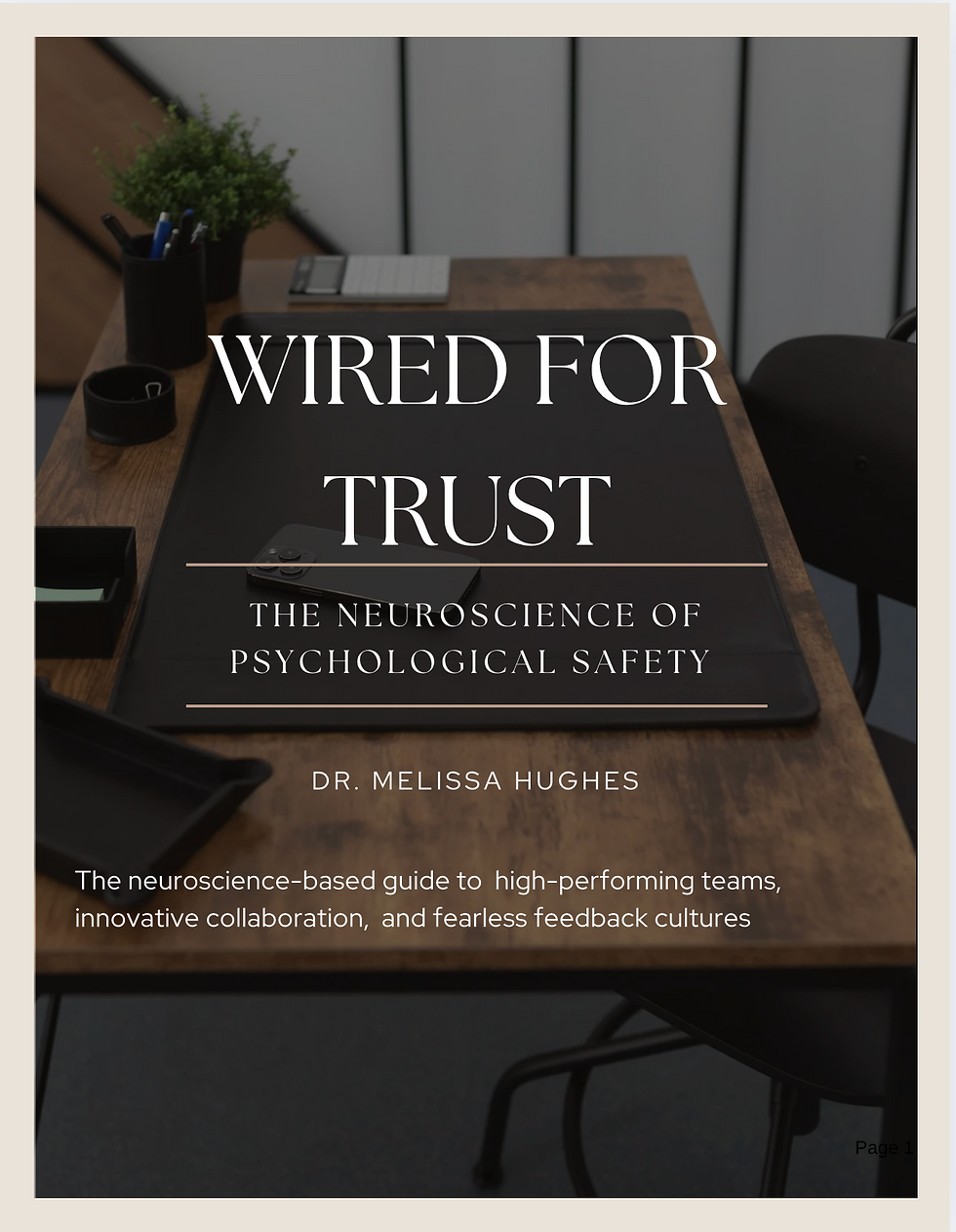
Wired for Trust: The Neuroscience of Psychological Safety is my illustrated, 52-page guide to how trust transforms teams, and what happens inside the brain when it's missing.
It blends brain science, leadership psychology, and real workplace stories into strategies you can use with your team on Monday morning.
Keep reading


Comments