


Your Chef Isn't the Only One Seasoning the Food

Updated: Sep 11
Your lighting is seasoning the food.
So is your playlist.
So is whoever chose the plates.
So is the server auctioning off a beautifully plated salmon, "Who got the salmon?"
This isn't just a figure of speech. It's a description of what the brain is actually doing while your guest eats. It's the reason two people can be served identical food in different rooms and walk out with genuinely different opinions about your kitchen.
The steak was cooked perfectly. The tomatoes were impossible. The wine was worth it. All of that may be true. But your guest's brain had already reached several conclusions about that meal before the first bite ever landed.
Taste is a Brainy Thing
Technically, yes, you taste with your tongue. Receptors there detect sweet, salty, sour, bitter, and umami. Five channels. That's the whole menu.
Everything else you think of as flavor happens in the brain. Your brain takes taste and combines it with smell, sight, sound, touch, temperature, memory, and expectation. Then it hands you a finished experience and lets you believe it came from your mouth. The crispy potato isn't satisfying only because of what's happening on your tongue. Part of that pleasure is the crunch you hear.
The dessert doesn't read as luxurious only because of the cream. Its weight, temperature, appearance, and the heft of the spoon in your hand are all in the mix. Even the font used to describe the dish influences us.
Charles Spence, the experimental psychologist who runs the Crossmodal Research Laboratory at Oxford, has spent decades on exactly this. His field is crossmodal perception, which is a technical way of saying that what happens in one sense changes what you perceive in another.
Restaurants are sensory laboratories that happen to serve cocktails.
Your Playlist is an Ingredient
Spence and Massimiliano Zampini sat people down with potato chips for a deeper dive. They played the crunch back to them through headphones, subtly amplified and brightened. The chips were identical. Every last one. People rated the ones that sounded crisper as crisper and fresher too. The work won an Ig Nobel Prize, which is what happens when a finding is funny and correct at the same time.
The sound didn't add anything to the chip. It told the brain where to aim. That is the mechanism worth holding onto because perception is relentlessly contextual. The brain doesn't sort sensory input into tidy independent boxes and grade each one separately. It fuses the signals and uses the result to answer a single question: what is happening to me right now?
Sonic seasoning is now a genuine area of study, and the findings are consistent. High-pitched music tends to push perceived sweetness up. Low, brassy sound brings out bitterness. The same dessert lands differently depending on what's playing over it.
Your playlist is not neutral. It's an ingredient you are currently using by accident. Most restaurants treat sound the same way they do the weather. It just kind of happens.
The crackle of a hot skillet crossing the room.
The pop of a cork.
The hiss of fajitas that turns heads all through the dining room.
Those aren't side effects. They're part of the product.
More on the sound research, including what your room's noise level does to guest perception and return intent, in **The Beat Behind the Bite: How Background Music Influences the Dining Experience.
The Plate is Talking Too
Betina Piqueras-Fiszman and Spence served 53 people the same strawberry mousse, half of it on a white plate and half on a black. The white plate version was rated sweeter, more flavorful, and better liked.
Nobody switched strawberries. What changed was the context the brain used to interpret them. Plating is not decoration. It's information.

Your Guest's Brain Places the Order Before Your Server Does
Here's the piece that matters most, and the one most operators have never been told. The brain is a prediction machine. It is constantly guessing what's about to happen, then checking the guess against what actually arrives.
So when a guest reads "velvety," "wood-fired," "slow-roasted," or "hand-finished," they have already received sensory information. The prediction is built. The food shows up afterward and gets measured against it.
Which means your menu copy isn't just describing ingredients. Your server isn't merely relaying information. Your room isn't just somewhere to put the tables. All three are writing the prediction that the food will be judged against.
Picture the same dish and two servers.
The first sets it down: "Here's the salmon."
The second sets it down: "This is our cedar-roasted salmon finished with a delicate citrus butter."
The dish is the same. But the guest receives it completely differently. Attention has been aimed, expectation has been built, and certain qualities of that fish just got louder.
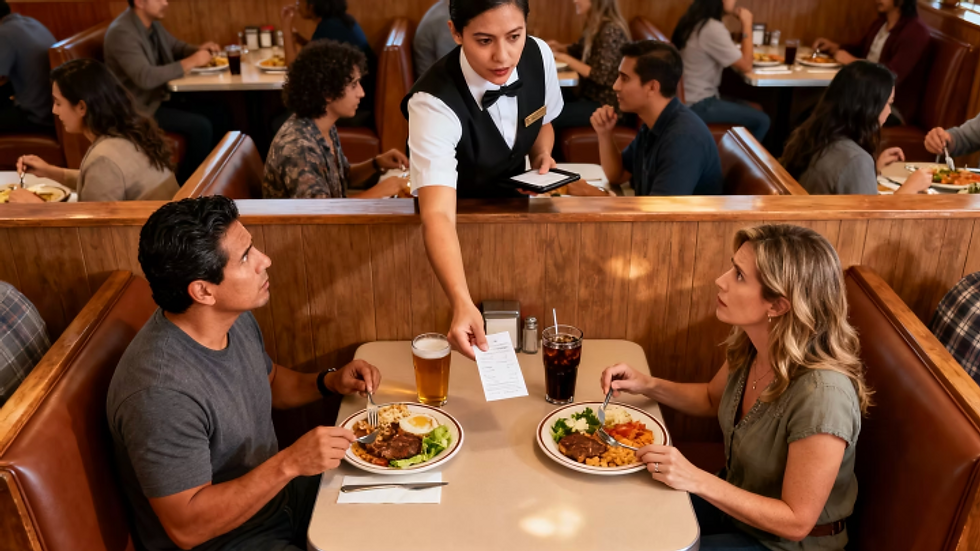
Now picture a third server who seems rushed, irritated, or somewhere else entirely. That goes into the experience too because the brain won't keep it separate.
We ask two questions when we review a restaurant. Was the food good? Was the service good? The brain has never once filed them separately. It gets one package.
There is No Such Thing as a Neutral Room
This is where the word ambiance does real damage. It sounds like decorating. Nice lighting, decent playlist, pretty room. From the brain's side of the table, none of that is decor. It's input.
Volume shifts attention and arousal. Lighting changes what the eye reports. Aroma moves appetite and flavor. Plateware sets visual and tactile expectations. Language primes specific qualities in the food. The server's mood moves the guest's mood.
Every one of those signals gets folded into the answer, and the answer is the meal your guest remembers. None of this means turning dinner into theater. Most restaurants shouldn't try, and the point was never that every entree needs a soundtrack.
The point is that your guests are already seeing, hearing, smelling, touching, and expecting something right now. Their brains are integrating all of it whether you designed it or not. So stop asking only whether the food is good and start asking the questions underneath it.
What does the guest see before the first bite?
What is the menu copy promising?
What does the server reinforce, and what do they flatten?
Does the plate make the food look better, or does it fight with it?
What sound owns the room at 7:30 on a Friday?
What in this experience tells the guest it was worth what we charged?
No one experiences food in isolation. Eating is one of the most multisensory experiences we engage in: the room, the people, the story, the expectation, and the plate as one continuous event.
The Takeaway: Elevate the Dining Experience
In conclusion, every aspect of the dining experience plays a crucial role in shaping perceptions. From the lighting to the playlist, each element contributes to the overall enjoyment of the meal. Understanding this interconnectedness can transform how we approach dining.
So, let's embrace the science of sensory perception. By being mindful of the environment we create, we can enhance the dining experience for our guests. After all, a meal is not just about food; it's about the entire experience.
Let’s unlock the full potential of our dining spaces and create unforgettable moments for every guest.


Comments